Expand description
§Order Actor
This module implements the Order resource actor with cross-actor coordination and validation.
§Overview
The Order actor demonstrates the most complex pattern: an actor with context dependencies. It coordinates with User and Product actors to validate orders and reserve inventory during order creation.
§Structure
entity-ActorEntityimplementation forOrdererror-OrderErrortype with automatic error conversion from dependenciesnew()- Factory function that creates the actor and client
§Message Flow: create_order
The following diagram shows how a create_order call flows through the system,
demonstrating actor-to-actor communication and validation:
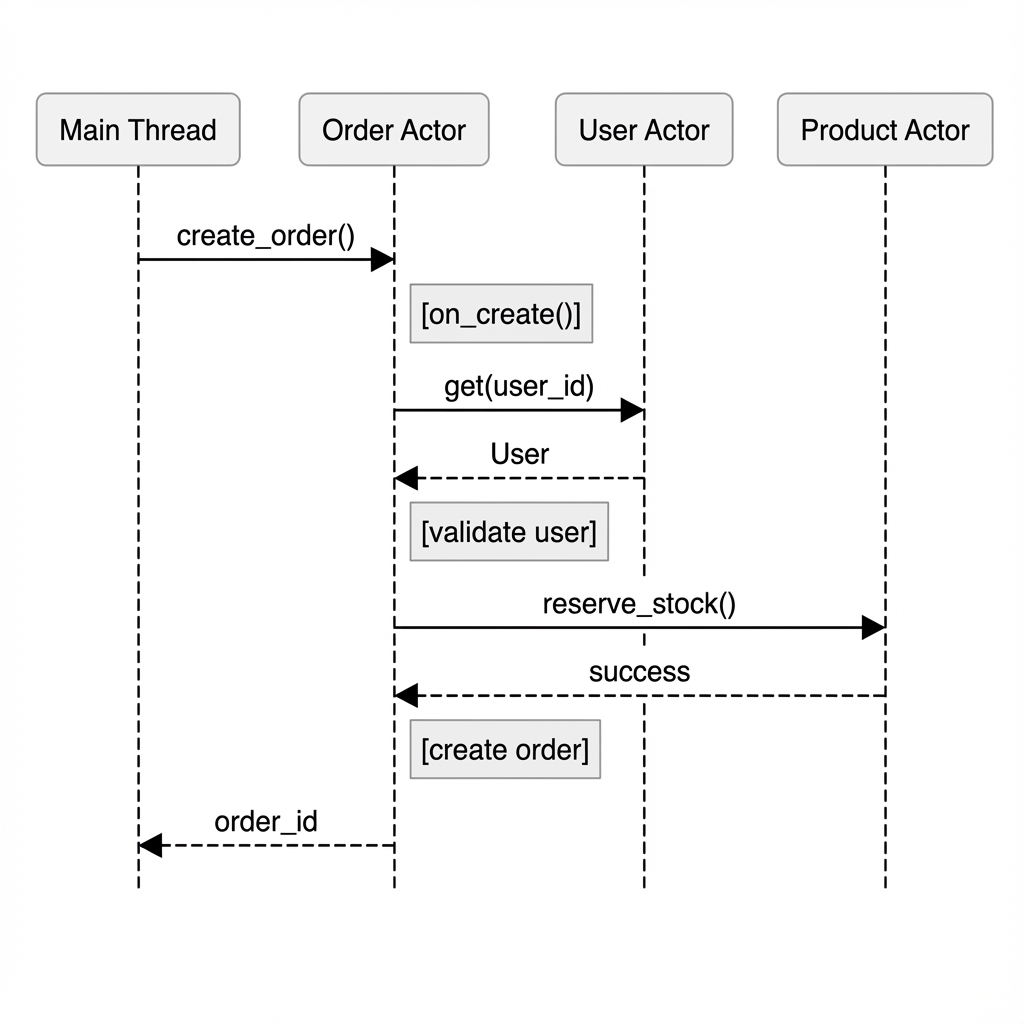
Key Points:
- All communication is asynchronous via message passing
- Each actor processes messages sequentially (no locks needed)
- Validation happens in
Order::on_create()before the order is stored - If any step fails, the entire operation fails atomically
§Context Dependencies
The Order actor requires User and Product clients in its context:
use actor_sample::order_actor;
use actor_framework::mock::MockClient;
use actor_sample::clients::{UserClient, ProductClient};
use actor_sample::model::{User, Product};

#[tokio::main]
async fn main() {
    // Create mocks for dependencies
    let user_mock = MockClient::<User>::new();
    let product_mock = MockClient::<Product>::new();

    let user_client = UserClient::new(user_mock.client());
    let product_client = ProductClient::new(product_mock.client());

    // Create actor and client
    let (actor, client) = order_actor::new();

    // Start with dependencies injected
    tokio::spawn(actor.run((user_client, product_client)));
}§Lifecycle Hooks
The Order actor uses the on_create hook to perform validation and coordination:
- Validate user exists - Queries User actor
- Reserve product stock - Calls Product actor’s
reserve_stockaction - Create order - Only if validation succeeds
This ensures orders are always valid and inventory is properly reserved.
§Error Handling
The Order actor demonstrates automatic error conversion with #[from]:
use thiserror::Error;
use actor_sample::user_actor::UserError;
use actor_sample::product_actor::ProductError;

#[derive(Debug, Error)]
pub enum OrderError {
    #[error("User service error: {0}")]
    UserService(#[from] UserError),  // Auto-converts UserError

    #[error("Product service error: {0}")]
    ProductService(#[from] ProductError),  // Auto-converts ProductError
}
This allows seamless error propagation from dependency actors.
§Key Features
- Context injection: Depends on
(UserClient, ProductClient) - Cross-actor coordination: Validates and reserves across multiple actors
- Automatic error conversion: Uses
#[from]for clean error handling - Lifecycle hooks: Uses
on_createfor validation logic
Re-exports§
pub use error::*;
Modules§
Functions§
- new
- Creates a new Order actor and its client.